
Sebi aims to stay proactive as HFT and quant firms like Citadel Securities, Optiver, Millennium, and IMC Trading are expanding rapidly in India, which is home to the world's largest derivatives market by contracts traded.

Promoters of India's top private listed companies have cut their stakes sharply since 2021, taking advantage of elevated valuations and reshaping ownership dynamics in the market. Holdings of promoters in the top 200 privately owned listed firms declined nearly 600 basis points (bps) to 37 per cent at the end of FY25, from 43 per cent in FY21.
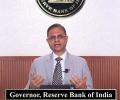
'India has the potential to grow at more than 7%, with the monetary policy providing a supportive hand.'
'Deposit and lending rates have started to fall considerably. It is likely to spur investment and consumption of durables.'

Large tariffs by the United States administration and elevated geopolitical risk have increased near-term global financial stability risks, and along with weather events pose downside risks to domestic growth, Reserve Bank of India (RBI) Governor Sanjay Malhotra said in the foreword to the Financial Stability Report released on Monday.
'Once bitten, twice shy, I didn't take up the challenge this time...' 'I realised I had failed to follow my karma because I feared failure.'

'The brand, the team, and the people have to make the transition from playing league matches to Test matches.'

'Many global investors have been overweight on dollar assets, so some diversification or hedging is naturally expected.'

Concerned over the rise in mis-selling of products by banks and non-banking financial companies (NBFCs), the Reserve Bank of India (RBI) is examining whether to come up with norms to curb such practices. Observing that pushing financial products, such as insurance, indiscriminately to unaware consumers may be detrimental to their well-being, RBI Deputy Governor M Rajeshwar Rao said, "We are examining whether it necessitates framing of guidelines to address mis-selling of financial products and services by REs (regulated entities)."

The interplay between domestic and foreign capital will shape India's equity markets.

Domestic institutional investors (DIIs), mostly mutual funds and insurance companies, overtook foreign portfolio investors (FPIs) in ownership of NSE-listed companies in the March quarter of 2025. According to Prime Database, DIIs held a 17.62 per cent stake, up from 16.89 per cent in the December 2024 quarter.

When Gensol Engineering made its public market debut through a small and medium enterprises (SME) initial public offering (IPO) in September 2019, its promoters held a commanding 96 per cent stake. Now, that figure has shrunk to a "negligible" fraction.

'Entering India is exciting, but it's also challenging. You have to be prepared for long-term investment.'

The Indian economy could remain less affected by global trade wars than other countries because the two engines of domestic growth - consumption and investment - are likely to face a limited impact from such headwinds, according to an article on the 'State of the Economy' in the Reserve Bank of India's (RBI's) bulletin, released on Tuesday.

Escalating trade tensions amid a tariff war after Donald Trump took over as President of the United States (US) could adversely impact global growth and fuel inflation, an article on the "State of the Economy" in the Reserve Bank of India (RBI) monthly bulletin said.

'In this age of competition, we will not survive long if we do not provide quality service to our consumers'

Global brokerage CLSA has lowered its target price for IndusInd Bank from Rs 1,200 to Rs 900 while maintaining an outperform rating on the stock after the private lender disclosed a net worth hit of Rs 1,500 crore due to an accounting gap. The revised price target still implies an upside of 34 per cent from current levels.

The changes will take effect on March 28, with portfolio adjustments expected before the market closes on March 27.

'The way the bank is doing in the past 4-5 quarters, no reason to see why we will not be able to achieve that.'

Reserve Bank of India (RBI) Governor Sanjay Malhotra said the repo rate cut in the February meeting of the monetary policy committee (MPC) was due to inflation aligning with the target and recognising the fact that monetary policy is forward-looking.
